EN



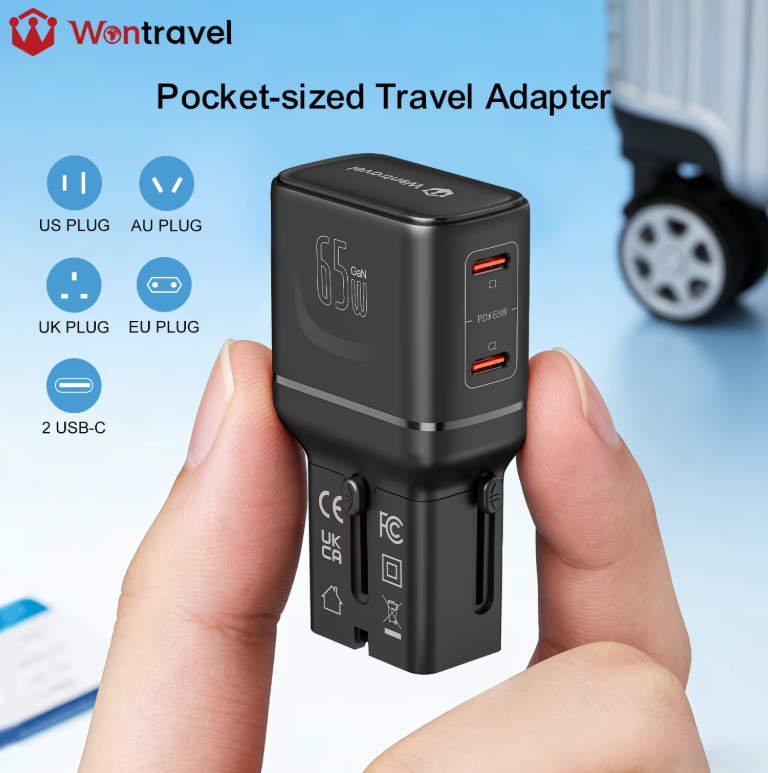
The universal travel adapter quietly saves every trip from a dead battery
Airport lounges and hotel rooms share one dirty little secret. The outlets never match the gadgets. A traveler from Chicago lands in Singapore with a phone at 8 percent, a laptop at 12 percent, and a smartwatch that has already given up. The wall socket looks like a science fair project. That moment of panic is exactly where a universal travel adapter earns its place in every carry-on.
This is not about exotic travel. Even a straightforward business trip from Frankfurt to Dallas exposes the problem. Lounge seating areas, hotel desks, and bedside tables all present different physical interfaces. A universal adapter turns that chaos into a predictable routine.
Why the standard hotel room outlet is a gamble
Hotel construction follows local electrical codes, not international traveler convenience. A property in London might offer three rectangular pins. A hotel in Tokyo uses two flat parallel blades. A boutique stay in Cape Town could present three round pins in a triangular pattern. The result is a patchwork that no single national plug can navigate.
Business travelers feel this most sharply in airport lounges. These spaces promise productivity between flights. The promise collapses when a laptop charger cannot physically enter the outlet. Lounge operators know this pain. Some now stock loaner adapters at reception, but supply runs out fast during peak departure banks.
The numbers tell a blunt story. The International Electrotechnical Commission tracks more than a dozen distinct domestic plug and socket standards in active use. A traveler crossing three regions in one week can easily face four different physical interfaces. Carrying a dedicated adapter for each one is impractical. That is the gap a universal travel adapter fills.
How a universal travel adapter actually handles multiple standards
The engineering inside a quality universal adapter is more interesting than a simple pin-swapping mechanism. Sliding or rotating pin assemblies engage different configurations while maintaining secure contact pressure. Internal metal strips route live, neutral, and ground paths to the correct positions for each standard.
A common misconception treats these devices as mere physical converters. Voltage and frequency remain separate concerns. A universal adapter does not change 100 volts to 230 volts. It only solves the mechanical connection. Devices with dual-voltage power supplies, which covers most laptops, phone chargers, and camera bricks, work fine once the plug fits. Single-voltage appliances like some hair dryers and older shavers need a separate voltage converter.
|
Region |
Common plug standard |
Typical voltage |
Typical frequency |
Traveler pain point |
|
North America |
Type A / B |
120 V |
60 Hz |
Two flat pins, no ground on many outlets |
|
Continental Europe |
Type C / F |
230 V |
50 Hz |
Round pins, recessed sockets |
|
United Kingdom |
Type G |
230 V |
50 Hz |
Three rectangular pins, fused plugs |
|
Australia / NZ |
Type I |
230 V |
50 Hz |
Angled flat pins |
|
India / South Africa |
Type D / M |
230 V |
50 Hz |
Thick round pins, limited compatibility |
That table explains why a single travel adapter with multiple pin options becomes a practical tool. It does not replace knowledge of voltage. It does replace the need to hunt down a local plug in a foreign city at 11 p.m.
The lounge and hotel front desk problem nobody talks about
Hotel front desks and lounge reception areas face a recurring operational headache. Guests ask to borrow adapters. Properties buy cheap units in bulk. Those units disappear, break, or fail safety checks. A front desk manager at a 200-room airport hotel once described a monthly adapter loss rate above 30 percent. That is not a guest behavior problem. It is a design and durability problem.
A universal travel adapter built for repeated use changes that math. Reinforced pin mechanisms, heat-resistant housing, and internal fuse protection matter in commercial settings. A flimsy adapter that arcs or overheats creates a fire risk in a densely occupied lounge. Safety certification is not a marketing bullet. It is the baseline.
Industry standards matter here. The IEC 60884 series covers plugs and sockets for household and similar purposes. Adapters sold into hospitality environments should demonstrate compliance with relevant clauses on insulation resistance, temperature rise, and mechanical strength. Buyers who ignore those details often discover the consequences through guest complaints or, worse, incident reports.
A real project story from a Southeast Asia airport lounge retrofit
A mid-sized airport lounge in Southeast Asia underwent a power access retrofit a few years ago. The original design specified local Type G outlets only, which matched the host country. Passenger feedback told a different story. International carriers based in North America and East Asia generated a steady stream of requests for adapters.
The operations team tried a loaner program with low-cost universal adapters. Within three months, nearly half the units showed cracked housings or loose pins. The failure pattern pointed to repeated insertion stress and heat buildup from poor internal contacts.
The replacement specification called for adapters with a higher contact force, a ceramic or high-grade thermoplastic body, and a resettable overcurrent protection element. The new units went into 40 seats across two lounges. After a year, the failure rate dropped to single digits. The lesson is straightforward. In high-traffic hospitality settings, the cheapest universal adapter is rarely the least expensive over time.
What hotel and lounge buyers should actually check
Procurement teams often evaluate travel adapters on unit price alone. That approach misses the real cost drivers in a commercial environment. A few practical checks separate a durable product from a landfill candidate.
- Pin engagement force. Weak springs or loose sliding mechanisms cause arcing and intermittent charging.
- Housing material. ABS plastic is common. Glass-filled nylon or polycarbonate handles heat and impact better.
- Internal fuse or breaker. A resettable element protects both the device and the outlet.
- Certification documentation. Look for test reports referencing IEC 60884 or equivalent national standards.
- Usability under stress. Can a guest insert a plug one-handed in a dimly lit lounge seat? If not, the design needs work.
These points do not guarantee a perfect product. They do filter out the most common failure modes reported by hospitality operators.
Where Wontravel fits into the supply chain picture
Wontravel, a National High-Tech Enterprise founded in 2008, brings a full stack of manufacturing capabilities to this category. The company handles product R&D, mold design and manufacturing, injection molding, circuit design, assembly, and quality control under one roof. That vertical integration matters for buyers who need consistent pin geometry, reliable internal contacts, and batch-level traceability.
For hospitality procurement teams, the practical advantage is a supply partner that understands both the technical requirements and the volume demands of commercial channels. Travel chargers, fast chargers, power strips, and wall sockets all come out of the same disciplined production system. A universal travel adapter from a manufacturer with that depth of process control is not a commodity gamble. It is a specification decision.
Table of Contents
- The universal travel adapter quietly saves every trip from a dead battery
- Why the standard hotel room outlet is a gamble
- How a universal travel adapter actually handles multiple standards
- The lounge and hotel front desk problem nobody talks about
- A real project story from a Southeast Asia airport lounge retrofit
- What hotel and lounge buyers should actually check
- Where Wontravel fits into the supply chain picture