EN



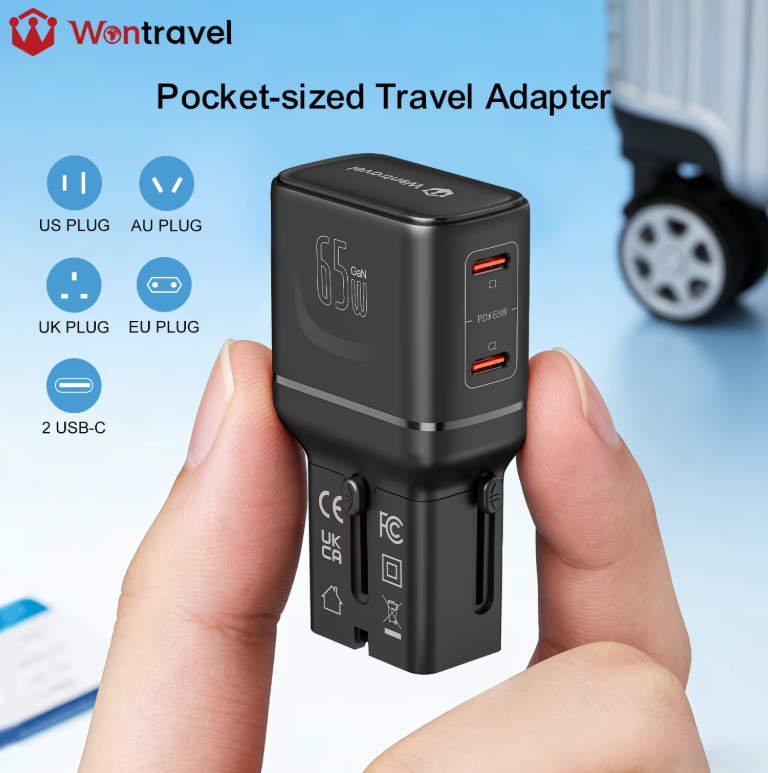
Why One Adapter Often Beats a Bag Full of Them
Family travel turns charging into a small logistics problem. Two adults, two kids, a tablet for movies, a laptop for remote work, smartwatches, earbuds, a camera, and a handheld game console can easily add up to eight or ten devices. Packing a separate plug adapter for each one is bulky and easy to forget. A universal travel adapter with several USB ports and one AC socket can cover most of that load, but only when the family understands what the adapter can and cannot do.
The appeal is not just convenience. One well-chosen universal travel adapter reduces the wall plugs needed in a room that may have only two accessible outlets. It also creates a single charging station, which makes it harder to leave cables behind. The catch is power sharing. A compact adapter rated for 65 W total may charge a laptop quickly when it is the only device connected, then slow down when three phones and a tablet join the party.
Map the Family's Charging Load Before Packing
Start with a device inventory, not with the adapter. List every item that needs power and note its charging input. USB-C has become common, but older cameras, fitness trackers, and kids' toys may still use micro-USB or a barrel plug. The plug type matters, and so does the power profile. A phone that accepts 20 W will not benefit from a 100 W port, while a laptop may refuse to charge at all from a 12 W USB-A port.
A useful habit is to group devices by charging priority. Overnight devices include phones, watches, earbuds, and tablets, which can share lower-power ports because there is no rush. Daytime devices include laptops, cameras, and power banks, which need the higher-output USB-C ports before a long flight or a day of sightseeing. Keeping the groups separate avoids plugging a laptop into a port already sharing power with three other gadgets.
The Difference Between Plug Conversion and Voltage Conversion
Many travelers learn this lesson the hard way. A universal travel adapter usually changes the shape of the plug so it fits a foreign wall outlet. It does not necessarily change the voltage. If the destination runs on 220 to 240 V and the device is only rated for 100 to 120 V, a simple plug adapter can damage the device or create a safety hazard. Dual-voltage devices, which often show a range such as 100 to 240 V, are fine with a plug adapter alone.
The International Electrotechnical Commission publishes IEC 60884-2-5, a standard covering adaptors for household and similar purposes. It addresses dimensional fit, electrical ratings, and construction details, but it does not turn a plug adapter into a voltage converter. High-power appliances such as hair dryers, travel kettles, or curling irons are usually the wrong load for a universal travel adapter. Those devices draw far more current than a compact adapter is designed to pass.
A Practical Power Budget for Mixed Devices
A family can plan around a shared power budget without doing complex math. The key is to know the adapter's total output and the realistic draw of each device. The table below shows typical ranges. Real numbers vary by brand and battery state.
|
Device |
Typical charging draw |
Best port |
Travel adapter reality |
|
Smartphone |
18 to 30 W |
USB-C PD or USB-A |
Easy, even with several phones |
|
Tablet |
20 to 45 W |
USB-C PD |
Shared power can slow charging |
|
Laptop |
45 to 100 W |
USB-C PD 65 W or higher |
Needs a high-output adapter |
|
Smartwatch and earbuds |
3 to 10 W |
USB-A or low-power USB-C |
Best charged overnight |
|
Camera |
8 to 15 W |
USB-C or dedicated charger |
Not suitable for most travel adapters |
|
Hair dryer or travel kettle |
800 to 1600 W |
AC outlet |
|
A 65 W adapter can usually handle a laptop plus two phones if the laptop is the priority. Two laptops at once may exceed the design. That does not mean the adapter is faulty. Checking the label before buying avoids disappointment at the airport or hotel lobby.
Cable, Port, and Nightly Charging Routines That Prevent Chaos
Cables matter as much as the adapter. A thin charging cable that came with a cheap accessory may not carry enough current for a laptop, even if the adapter port is rated for 65 W. USB-C cables with e-marker chips are often needed for higher power, a detail covered by the USB Implementers Forum's Power Delivery specification. A short, sturdy cable for each device type reduces confusion and keeps the charging station tidy.
Port labels help. If the universal travel adapter has one 65 W USB-C port, two 20 W USB-C ports, and two USB-A ports, roles become obvious. The 65 W port goes to the laptop or power bank. The 20 W ports handle phones and tablets. The USB-A ports take watches, earbuds, and cameras. Tape with a name or color can stop arguments between siblings.
Nightly charging is the easiest routine. Plug in high-priority devices first, then add low-power items before bed. In the morning, unplug everything and check the outlets again.
When a Universal Adapter Is Not the Right Tool
Honesty matters. A universal travel adapter is not a universal power solution. It may not support grounding in every socket type, and older buildings can have outlets that grip plugs poorly. High-power heating appliances should stay home or use a proper voltage converter with enough capacity. Devices with motors, compressors, or sensitive electronics may need manufacturer guidance abroad.
A 2022 field audit at a family resort in Southeast Asia collected 120 guest adapters. About 42 percent showed loose contact or heat marks after repeated use, and 31 percent had powered devices asking for more than 100 W. Most failures came from overloading, poor plug fit, or using a plug adapter where a voltage converter was needed.
For families, the sweet spot is a compact universal travel adapter with well-marked ports, a grounded AC socket where available, and enough total output for the largest device plus a few small ones. Wontravel, the short name behind the manufacturing operation, supports that approach through in-house mold design, injection molding, circuit layout, and assembly checks, helping keep plug fit and USB power negotiation consistent across production batches.
Table of Contents
- Why One Adapter Often Beats a Bag Full of Them
- Map the Family's Charging Load Before Packing
- The Difference Between Plug Conversion and Voltage Conversion
- A Practical Power Budget for Mixed Devices
- Cable, Port, and Nightly Charging Routines That Prevent Chaos
- When a Universal Adapter Is Not the Right Tool