EN



Why One USB Travel Adapter Can Shrink a Bag Full of Wall Chargers
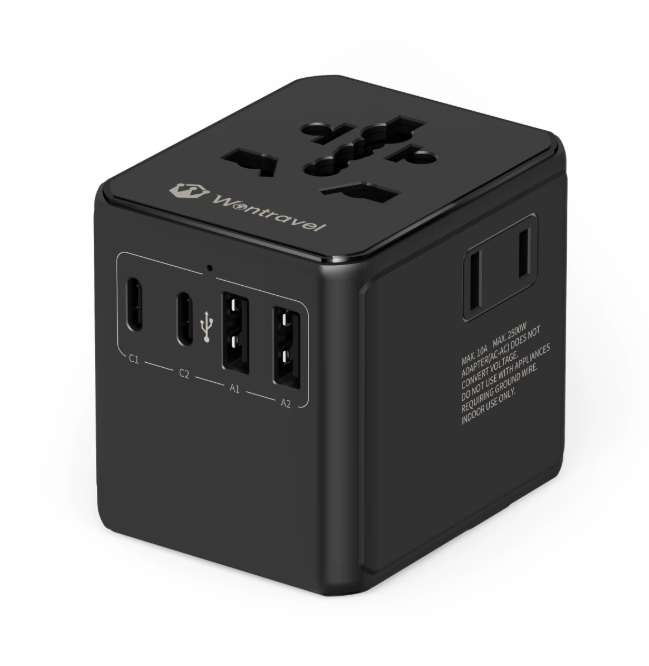
A travel charging pouch often tells a story before a trip starts. There is the phone brick from an old upgrade, a tablet charger that works with one cable, a laptop power supply big enough to block two outlets, and a nest of mystery USB cables. Each item seems reasonable alone. Together, they waste space and create daily friction. A usb travel adapter helps by combining plug conversion and USB power delivery into one tool, so fewer separate wall chargers need to come along.
That does not mean one gadget powers every device. It means the common mix of phones, tablets, headphones, cameras, and some laptops can often share one well-designed adapter.
The Hidden Cost of Carrying Several Wall Chargers
Weight is the obvious cost. Friction is the larger one. Multiple wall chargers create small problems that pile up during a trip.
1.Outlets become scarce in hotel rooms, airports, trains, and cafes.
2.Chargers get lost when left in seat pockets or borrowed by coworkers.
3.Cable confusion grows because each charger may want a different port.
4.Packing takes longer when every departure becomes an inventory check.
There is also a safety angle. Cheap chargers stacked into a loose power strip or worn outlet can warm up. A compact multi-port adapter does not replace good electrical habits, but it reduces the number of bulky plugs hanging from a wall.
What Makes a USB Travel Adapter Different Inside
A basic plug adapter only changes the metal pins. It does not convert voltage, and it does not create USB ports. A usb travel adapter with built-in USB outputs accepts a wide input range, commonly 100 to 240 volts at 50 or 60 hertz, then converts alternating current into the low-voltage direct current that phones and laptops expect.
The important parts are hidden. A switched-mode power supply manages conversion. USB Power Delivery, or USB PD, lets adapter and device negotiate a safe voltage and current. USB Implementers Forum introduced USB PD 3.1 with support for up to 240 watts, though many travel adapters sit in lower power classes. Safety standards such as IEC 62368-1 guide the design of information technology equipment.
Multi-port sharing is the detail buyers miss most. A 65 watt adapter with two USB-C ports and one USB-A port may not send 65 watts to every port at once. Total output is shared. When a laptop and tablet charge together, each may receive less power. Port labels and total output matter more than one big number on the box.
A Field Example from a Chemical Plant Retrofit in Southern China
A project team working on a chemical plant retrofit in southern China ran into this issue in a temporary site office. The trailer had two double outlets. The crew needed to charge explosion-proof radios, two laptops, a tablet, phones, and a portable gas detector. Five or six separate wall chargers turned the desk into a tangle. Plugs blocked each other, and one laptop brick took up space.
The team swapped several small chargers for two multi-port USB travel adapters with USB-C PD. Radios, phones, and the tablet moved to the shared adapter. Laptops used the higher-power USB-C ports, while one older laptop kept its dedicated supply because it needed more power than the shared ports could deliver. The desk became easier to use, and fewer chargers disappeared into toolbags.
The lesson was practical. Consolidation works best for low and medium power devices. High power tools, large laptop supplies, and anything with a heating element still deserve their own connection.
Where a USB Travel Adapter Still Has Limits
Honesty matters more than hype. A travel adapter with USB ports is not a universal power station. High wattage appliances such as hair dryers, kettles, and irons draw far more power than USB ports can provide. Some gaming laptops and mobile workstations need 180 watts or more. Grounding can also be a concern when a device has a three-prong plug and the local outlet lacks a proper earth connection.
|
Device or load |
Typical power draw |
Covered by a multi-port USB travel adapter? |
Key caveat |
|
Smartphone |
18W to 30W |
Yes |
Needs a suitable cable and PD port |
|
Tablet |
30W to 45W |
Usually |
Shared ports may slow charging |
|
Ultrabook |
45W to 65W |
Often |
Requires a 65W or higher USB-C PD port |
|
Gaming laptop |
180W to 240W |
No |
Dedicated power supply remains necessary |
|
Hair dryer or kettle |
1000W to 1800W |
No |
USB adapter cannot run high wattage AC appliances |
|
Camera or drone batteries |
30W to 60W |
Depends |
Some brands use proprietary charging |
The table explains why a traveler may still carry one large power supply. The goal is not zero chargers. The goal is fewer unnecessary ones.
How to Pick a Travel Adapter That Earns Its Space
A useful USB travel adapter should match the trip, not a marketing checklist. Start with plug standards for the destination. Then check input voltage range. Next, look at USB-C PD support and total output across all ports. Cable quality is not an afterthought, because a high-power port with a weak cable behaves like a low-power port.
- Confirm the adapter works with outlet types used in the destination region.
- Check that the input range covers 100 to 240 volts, common for international travel.
- Choose USB-C PD ports for laptops and tablets, and keep USB-A for older accessories.
- Read total wattage, not just the largest single-port claim.
- Prefer models with clear certification marks and a sturdy housing.
- Pack one reliable USB-C cable rated for the highest power device in the bag.
For buyers sourcing travel charging products, manufacturing discipline shows in mold fit, solder quality, thermal design, and consistent testing. Wontravel, a National High-Tech Enterprise founded in 2008, handles product R&D, circuit design, mold manufacturing, injection molding, assembly, and quality control. That vertical capability helps explain why some travel adapters feel solid over time while others loosen, buzz, or run hot.
Table of Contents
- Why One USB Travel Adapter Can Shrink a Bag Full of Wall Chargers
- The Hidden Cost of Carrying Several Wall Chargers
- What Makes a USB Travel Adapter Different Inside
- A Field Example from a Chemical Plant Retrofit in Southern China
- Where a USB Travel Adapter Still Has Limits
- How to Pick a Travel Adapter That Earns Its Space