EN



Why Sparking Happens at the Moment of Insertion
A universal travel adapter rarely sparks from a mysterious defect. The flash usually comes from a race: plug pins touch live receptacle contacts before a solid metal-to-metal junction forms. For a few milliseconds, current squeezes through a tiny contact patch. That patch heats, ionizes air, and creates a micro-arc. Contact bounce makes it worse because pins skip and settle, so the arc can strike more than once. Load side matters too. If a charger or hair dryer is already connected, the adapter may carry current the instant pins kiss the outlet. At the AC peak, inrush current can be several times the steady draw. A cheap adapter with thin pins and loose clips turns that moment into a tiny welding event. A well-built unit controls geometry, spring pressure, and materials so contact area grows fast and stays stable.
Contact Geometry and Material Choices That Change the Outcome
The first defense is mechanical. Good pins are not random brass rods. They are dimensioned to common receptacle standards, with chamfers and polished tips that slide in without catching. Internal clips need enough elastic travel to grip pins across tolerances. Phosphor bronze and beryllium copper are common because they hold spring force after repeated insertions. Nickel plating resists wear and oxidation. Silver alloys can lower contact resistance, though they cost more and may tarnish in sulfur-rich air. The table below shows how design choices shift the risk profile.
|
Design factor |
Low-cost adapter |
High-quality universal travel adapter |
Effect on sparking |
|
Pin finish |
Rough, thin plating |
Chamfered, polished, controlled |
Smoother entry, fewer bounces |
|
Contact spring |
Bent brass strip |
Phosphor bronze or beryllium copper |
Stable clamp force, larger contact area |
|
Plating |
Thin nickel or none |
Nickel with selective silver |
Lower resistance, less oxidation |
|
Safety shutter |
Basic or absent |
Sequential shutter and lock |
Live parts isolated until aligned |
|
Overcurrent limit |
Slow fuse, if any |
Fast fuse or breaker |
Limits fault energy |
A high-quality universal travel adapter cannot change the wall receptacle, but it can make the plug side more predictable. That predictability is what reduces sparking.
Load, Timing, and the Surge Hidden in a Simple Plug-In
Spark intensity depends on when insertion happens in the AC cycle and what the adapter feeds. An empty adapter has almost no current to interrupt. A 65 W laptop charger has input capacitors that charge in a short burst. A travel hair dryer may pull 1,000 W or more, and its motor adds startup surge. Plugging that load into an adapter already live in the wall puts full inrush through the contacts. The better sequence is to seat the adapter fully in the wall first, then connect the device. Some high-quality adapters include a switch or resettable breaker that keeps output dead until the body is locked. That removes load from the insertion event. A loose receptacle can arc even with a premium adapter, so the outlet deserves a quick check.
Safety Shutters, Interlocks, and Arc-Suppression Details
Safety shutters are often sold as child protection, but they also reduce sparking. A proper shutter blocks live contacts until both pins are aligned and pushed evenly. That prevents one pin from brushing a live contact at an angle. Better adapters use a sliding carriage or rotating block that will not change voltage configuration while pins are deployed. This interlock matters because some travelers force a slider after the adapter is already plugged in. The result can be a momentary short or a serious arc. Arc suppression comes from fast separation, wide contact gaps, and materials that resist arc tracking. A fuse or breaker with adequate interrupting rating limits energy if a contact welds or a foreign object bridges the gap. Standards such as IEC 60884-1 and UL 498 cover temperature rise, mechanical endurance, and construction details for plugs and receptacles.
A Field Case from a Coastal Hotel Retrofit
During a 2023 retrofit of a 180-room coastal hotel, crews kept finding small burn marks on guest room outlets. The complaint was "the adapter sparks when plugged in." Three issues overlapped. The hotel had older receptacle clips with weak spring pressure. Many guests left laptop chargers connected to the adapter before pushing the assembly into the wall. Cheap room adapters had thin pins with nickel plating rubbed down to brass. In one room, a 1,500 W hair dryer had been used through a travel adapter, and an internal contact had discolored from heat. The fix was not one part. Crews replaced worn receptacles, supplied better adapters with stronger clips and shutters, and added a card asking guests to plug the adapter into the wall before connecting devices. Follow-up checks found fewer burn marks and no repeat arcing reports in treated rooms. The case shows a key point: insertion sparking is usually a system problem, not just a product label.
What a High-Quality Adapter Can and Cannot Do
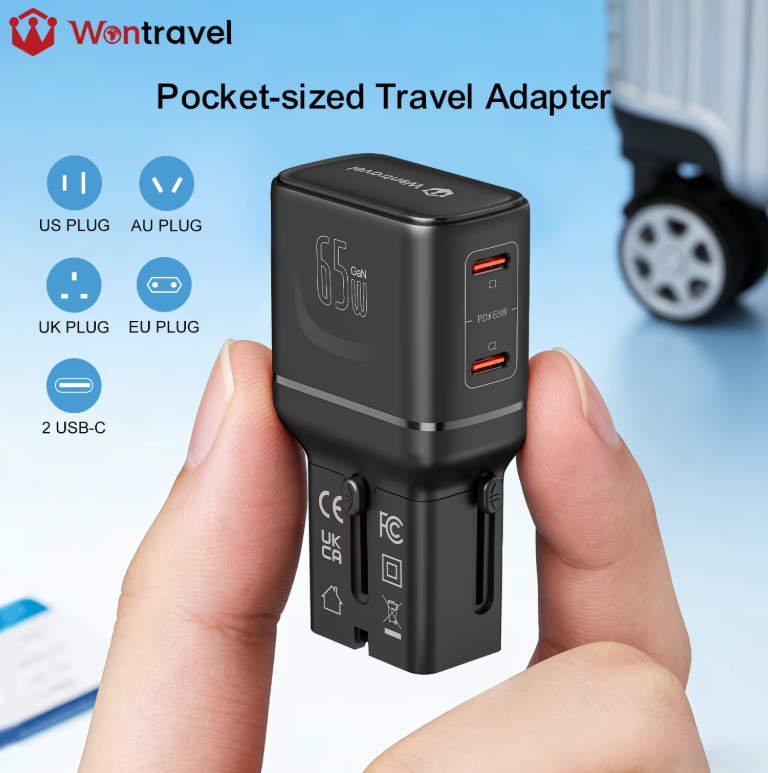
A high-quality universal travel adapter reduces sparking by controlling the contact event. It guides pins straight, maintains spring force, isolates live parts until alignment, and limits fault energy. No adapter can fix a cracked receptacle or a 20-year-old outlet with tired springs. No adapter should feed a high-power appliance unless its ratings clearly allow that load. Even the best design will show a tiny flash sometimes, especially on 230 V systems at peak voltage. The goal is to avoid repeated, energetic arcs that pit contacts, create carbon tracks, and turn a small inconvenience into a fire risk. Simple habits help: seat the adapter first, connect the device second, check for heat, and stop using any adapter that rattles or smells hot. Wontravel, a National High-Tech Enterprise founded in 2008, brings R&D, mold making, injection molding, assembly, and quality control under one roof. That setup helps explain how contact geometry, spring force, and material selection get controlled before a travel adapter reaches a suitcase.
Table of Contents
- Why Sparking Happens at the Moment of Insertion
- Contact Geometry and Material Choices That Change the Outcome
- Load, Timing, and the Surge Hidden in a Simple Plug-In
- Safety Shutters, Interlocks, and Arc-Suppression Details
- A Field Case from a Coastal Hotel Retrofit
- What a High-Quality Adapter Can and Cannot Do