EN



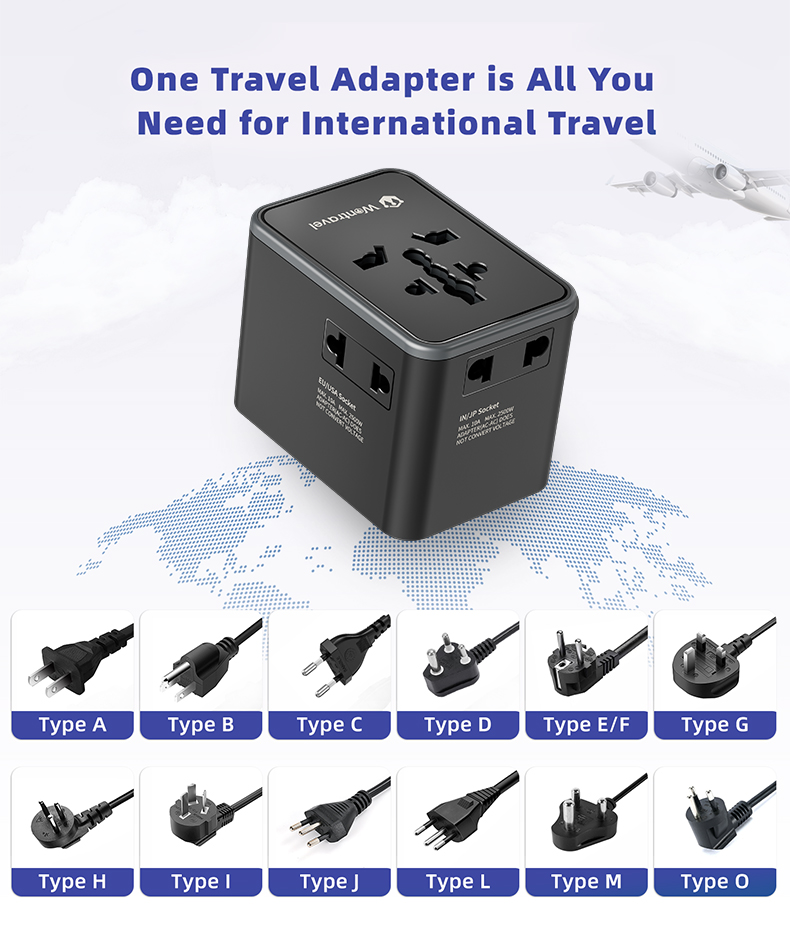
Why the Wall Plug Is Only Half the Story
Most travelers assume charging speed is dictated by the adapter’s physical size or the prongs that fit into a foreign outlet. That assumption misses the real bottleneck. A standard travel adapter is essentially a passive pass-through device. It converts plug shapes, nothing more. The charging intelligence, or lack of it, sits in whatever USB power brick gets paired with it. A usb travel adapter that actually delivers faster charging is doing something fundamentally different. It houses active circuitry that negotiates power delivery with the connected device, manages heat, and allocates current across multiple ports. The difference between a $5 plug converter and a $40 intelligent adapter is roughly the difference between a hallway and a traffic control system. Both get you through, but only one handles volume without a pileup.
The Handshake That Decides Everything
Fast charging starts with a conversation. When a phone or laptop connects to a USB-C port, it does not simply draw whatever current is available. It requests a specific voltage and current profile using protocols like USB Power Delivery (USB PD) or Qualcomm Quick Charge. A standard adapter lacks the controller to respond to these requests. It defaults to 5V and whatever amperage the port can safely provide, typically 1A to 2.4A. That translates to 5W to 12W, enough for a slow overnight top-up but painful when a traveler has 45 minutes between flights.
An intelligent usb travel adapter carries a PD controller that participates in this negotiation. It can offer 9V, 12V, 15V, or even 20V profiles, depending on what the device requests and what the adapter’s internals can sustain. The handshake happens in milliseconds, and the device settles on the highest mutually supported profile. This is why a laptop that charges slowly on a generic adapter can jump to full-speed charging on a PD-capable unit. The adapter is not forcing power into the device. It is answering a question the device is asking.
GaN Semiconductors and the Heat Problem
Power conversion generates heat. Traditional silicon-based chargers waste a meaningful fraction of input energy as thermal loss, and that heat becomes the limiting factor. Components must be spaced apart, heatsinks added, and the enclosure designed to dissipate. The result is a bulky brick that still throttles under sustained load.
Gallium nitride (GaN) transistors change the thermal equation. GaN switches faster and conducts with lower resistance than silicon, which means less energy is lost as heat during conversion. A GaN-based usb travel adapter can run cooler at the same power output, or deliver more power in the same thermal envelope. This is not marketing fluff. The physics is well documented in power electronics literature, and the practical result is that a compact adapter the size of a matchbox can sustain 65W output without cooking itself.
The table below compares typical charging profiles across adapter generations:
|
Adapter Type |
Typical Max Output |
Voltage Profiles |
Heat Dissipation |
Multi-Port Behavior |
|
Basic plug converter |
5W–12W |
5V fixed |
Low (passive) |
None, single port |
|
Silicon fast charger |
18W–30W |
5V/9V/12V |
Moderate, throttles under load |
Shared, often drops to 5V |
|
GaN PD travel adapter |
45W–100W |
5V/9V/12V/15V/20V |
Low, sustained output |
Intelligent allocation per port
|
When Multiple Devices Compete for Juice
A traveler rarely charges one device. Phone, tablet, earbuds, maybe a laptop. A standard adapter with multiple ports often splits power in a dumb way. Plug in a second device and the first port drops to 5V, triggering a slow-charge notification. The adapter is not prioritizing anything. It is just dividing whatever fixed budget exists.
An intelligent usb travel adapter with a microcontroller manages this differently. It reads the power request from each connected device and allocates accordingly. A laptop might get 45W while a phone gets 18W and earbuds get 5W. If the laptop disconnects, the controller redistributes that headroom to the remaining ports. This dynamic allocation is firmware-driven, and it is the reason two adapters with identical port counts can behave very differently in practice.
During a retrofit project at a business hotel in Shenzhen, the engineering team swapped out bedside USB outlets for PD-capable modules. The original outlets delivered a flat 5V 2.4A per port, and guests routinely complained about slow charging. After the swap, the same physical footprint delivered 30W on a single port or 18W plus 12W when both were occupied. The hotel did not change its electrical infrastructure. The difference was entirely in the negotiation and allocation logic.
Real-World Limits Worth Knowing
Faster charging is not universal. Three constraints matter. First, the device itself must support the fast-charging protocol. A five-year-old phone with micro-USB and no PD support will not benefit from a 65W adapter. Second, cable quality matters. A thin, unmarked USB-C cable may lack the e-marker chip that communicates current capacity, and the adapter will default to a safe but slower profile. Third, sustained high-wattage output depends on ambient temperature. In a hot car or a poorly ventilated outlet, even a GaN adapter will derate to protect itself.
The USB Implementers Forum publishes the USB PD specification, and the current revision (USB PD 3.1) extends the range up to 240W for compatible devices. That standard exists precisely because the negotiation protocol, not the plug shape, defines what is possible. A travel adapter that complies with PD 3.1 can legitimately claim faster charging across a broad device ecosystem, provided the cables and devices cooperate.
What This Means for Travel Gear
The practical takeaway is straightforward. A usb travel adapter earns the “faster charging” label when it contains active PD negotiation, thermal design that sustains output, and firmware that allocates power intelligently across ports. The plug conversion is table stakes. The electronics behind the port are what travelers actually feel when they are rushing between connections.
Wontravel has been building travel charging hardware since 2008, with in-house mold design, injection molding, and circuit development under one roof. That vertical integration means the PD controller, thermal layout, and enclosure are designed together rather than sourced separately. For buyers evaluating travel adapters, the manufacturing depth behind the product often explains why one unit holds 65W without throttling while another struggles at 30W.
Travel adapters are essential for charging electronics in foreign countries
Why a Tiny Piece of Plastic Decides Whether Your Trip Starts Smoothly
You have probably seen it happen at an airport charging station. A traveler crouches near the only open outlet, holding a phone and a plug that simply will not fit, while a boarding call echoes overhead. That small moment captures a reality most people ignore until they are standing in a foreign terminal: electrical outlets are not universal, and a travel adapter is the one accessory that turns a dead device into a working one. For anyone carrying a phone, laptop, camera, or e-reader across borders, a travel adapter is not a nice-to-have. It is the difference between staying connected and being stranded with a brick.
The Physical Reality Behind Different Wall Outlets
The first thing to understand is that a travel adapter solves a mechanical problem before it solves an electrical one. Plug shapes vary wildly. North America leans on the two flat pins of Type A and the grounded Type B. Much of Europe uses the round pins of Type C and Type F. The UK and parts of the Middle East rely on the chunky three-pin Type G. Australia and China use Type I. A plug designed for one system physically cannot enter a socket built for another, no matter how carefully you push.
There is a second layer that catches people off guard: voltage and frequency. A travel adapter changes the shape of the connection, not the electricity flowing through it. A device rated for 120 volts plugged into a 230-volt socket through a simple adapter can be damaged, sometimes permanently. The practical lesson is to read the fine print on every charger. Most modern phone and laptop chargers are dual-voltage, marked as 100–240V, which means a plug adapter alone is enough. Hair dryers, curling irons, and some small appliances often are not, and those need a voltage converter, not just an adapter.
A Data-Driven Look at Plug Types and Regional Standards
The table below summarizes common outlet standards and the voltage and frequency that travelers encounter. The data reflects widely published national standards and is worth keeping handy when packing.
|
Region |
Common Plug Types |
Typical Voltage |
Frequency |
|
United States, Canada, Mexico |
A, B |
120V |
60Hz |
|
United Kingdom, Ireland, UAE, Singapore |
G |
230V |
50Hz |
|
Most of Continental Europe |
C, E, F |
230V |
50Hz |
|
Australia, New Zealand, China |
I |
230V |
50Hz |
|
Japan |
A, B |
100V |
50Hz / 60Hz |
|
India |
C, D, M |
230V |
50Hz |
A quick glance at this table reveals why a single travel adapter rarely covers a multi-country itinerary. A trip from the US to the UK to France requires at least three different plug interfaces. This is exactly why universal travel adapters, which combine several pin configurations into one compact body, have become standard gear for frequent flyers. Still, even a universal adapter has limits, and understanding those limits matters more than the marketing claims on the box.
Where Cheap Adapters Fail and Why It Matters
Not all adapters are built the same, and the difference shows up in ways that are not always visible. In one infrastructure upgrade project at a chemical plant in southern China, engineers traced intermittent power interruptions in a temporary office area to a batch of low-cost adapters used with imported testing equipment. The adapters had loose internal contacts that arced under load, and thermal imaging later showed hot spots near the pin junctions. The fix was not complicated, but the lesson was clear: an adapter carries current, and any weak point in its construction becomes a failure point.
The technical mechanism is straightforward. Every connection has contact resistance, and resistance under current produces heat. Poorly made adapters use thin brass or plated steel pins, weak spring clips, and undersized internal wiring. Under a laptop charger drawing 65 watts or more, those weaknesses show up as voltage drop and heat. A well-made adapter uses thicker copper alloys, firm contact pressure, and a housing made from flame-retardant material. Safety certification matters here. Look for marks such as UL, CE, or CCC, which indicate the product has been tested against recognized safety standards. These marks are not a guarantee of perfection, but they are a meaningful baseline.
Practical Advice for Choosing and Packing Adapters
The best approach is to plan around the actual devices in the bag rather than around the destination alone.
1.Check the input rating on every charger. If it reads 100–240V, a plug adapter is sufficient.
2.Carry one universal travel adapter for the main charging hub and a spare simple adapter as backup.
3.Avoid plugging high-power appliances such as hair dryers into a universal adapter unless the adapter explicitly supports that load.
4.Keep adapters in a dedicated pouch so pins do not bend or scratch other items.
5.Test the adapter at home before departure with the actual charger that will be used.
These steps take a few minutes and prevent most of the unpleasant surprises that occur when a device refuses to charge in a hotel room. A universal travel adapter with a built-in USB port can also reduce the number of separate chargers in a bag, which simplifies packing and reduces clutter.
What to Look for in Build Quality and Manufacturing
The gap between a reliable adapter and a problematic one usually comes down to manufacturing discipline. Contact materials, spring tension, housing tolerance, and internal soldering all matter, and none of those are visible from the outside. This is where the supply chain behind the product becomes relevant. Wontravel, a National High-Tech Enterprise founded in 2008, operates an integrated process that covers product R&D, mold design and manufacturing, injection molding, circuit design, assembly, and quality control. That kind of vertical capability allows consistent control over the small details that determine whether an adapter holds up after months of travel. For buyers sourcing travel charging products, working with a manufacturer that controls its own tooling and assembly lines is a practical way to reduce variability and ensure the product meets recognized safety expectations.