EN
EN



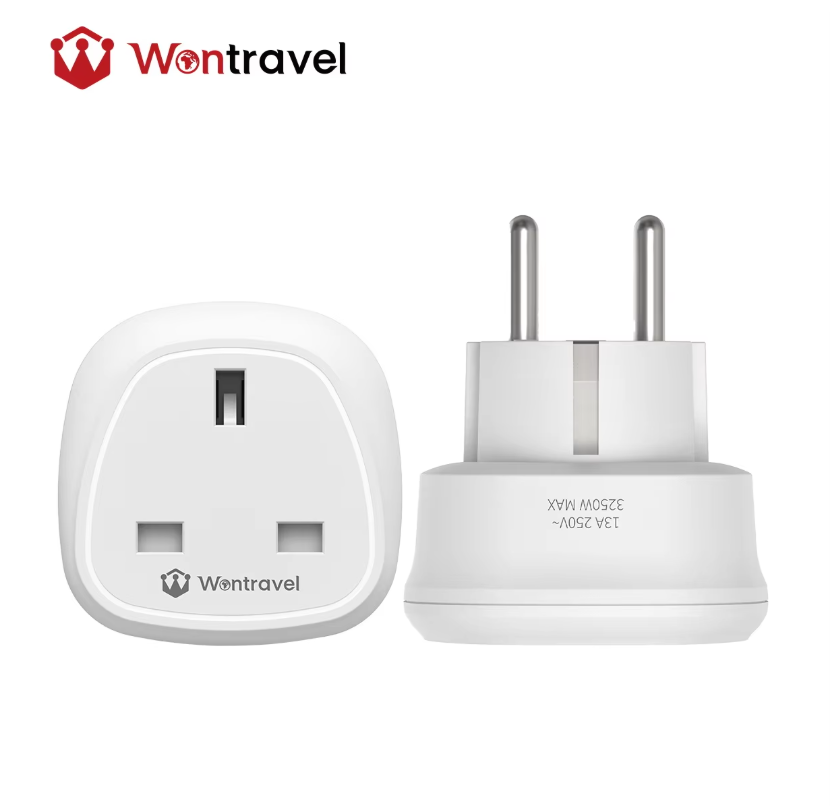
The Physical Pin Configuration and the 4.8mm Standard
Pick up a dedicated European travel adapter and the first thing noticed is the distinctive round pin geometry. These are not the flat, parallel blades familiar to North American travelers or the chunky rectangular prongs of a British plug. The European standard uses two round pins, each precisely 4.8 millimeters in diameter, spaced 19 millimeters apart from center to center. These dimensions are not arbitrary design choices. They are codified in the CEE 7 standard that governs domestic electrical connectors across most of continental Europe, and any adapter that deviates from these measurements, even by a fraction of a millimeter, will either fail to insert into a socket or will sit loosely, creating an intermittent contact that arcs and overheats. The pin length matters equally. A pin that is too short may not reach the internal contacts deep within a recessed European socket. A pin that is too long leaves exposed conductive metal between the adapter body and the socket face, a shock hazard that no responsible manufacturer should permit. Many adapters also incorporate a thinner variant known as the Europlug, with pins measuring 4.0 millimeters in diameter, designed for low-power, double-insulated devices up to 2.5 amperes. This slim profile allows the Europlug to fit into a wider range of European socket types, including some older Italian and Swiss designs that a full-sized 4.8mm plug might not enter. A well-engineered adapter often combines both capabilities, offering a full-sized 4.8mm plug for secure, high-current connections while remaining compatible with the broader Europlug standard for lighter loads. The feel of a properly dimensioned plug sliding into a socket is distinctive: a smooth, firm insertion with a satisfying retention that inspires confidence the connection will hold overnight.
The Hybrid Earthing Solution for Continental Compatibility
The earthing system inside a quality EU travel adapter is arguably its most sophisticated engineering feature, and it is the one that most users never see or think about. The European continent does not use a single earthing standard. Germany, Spain, the Netherlands, and much of Northern and Eastern Europe use the Type F Schuko socket, which grounds through two spring-loaded metal clips on the inner rim of the recessed socket that contact corresponding metal plates on the plug. France, Belgium, Poland, and several other countries use the Type E socket, which grounds through a solid metal pin that protrudes outward from the socket face and inserts into a hole on the plug body. A travel adapter designed to work reliably everywhere between Paris and Warsaw must accommodate both systems without compromise. The solution is a hybrid earthing design. The adapter body includes a female earth receptacle on its face to accept the protruding French earth pin, and it also incorporates metal side contacts on its body that engage with the German spring clips. These two earthing pathways are internally bonded to a single earth conductor that passes through to the output socket on the front of the adapter. This dual earthing strategy ensures that a Class I appliance, one that relies on an earth connection for safety, remains properly grounded regardless of which country the traveler plugs into. The absence of this feature is a serious safety deficit. An adapter that provides only one earthing method or, worse, has a non-functional earth pin that is purely cosmetic, leaves connected appliances without their primary fault protection. Checking for metal earth contacts on both the face and the sides of the adapter body is a quick visual test that separates a professionally engineered unit from a superficial imitation.
Internal Safety Engineering and the Role of the Fuse
Opening a well-made EU travel adapter reveals a level of internal engineering that the plastic exterior conceals. The conductors that carry current from the wall socket to the output receptacle are not simple bent metal tabs. They are shaped from brass or phosphor bronze, materials chosen for their combination of good conductivity and spring temper that maintains clamping force through thousands of insertion cycles. The contact points where these conductors meet the inserted plug pins are often reinforced with dimpled or ribbed surfaces that increase contact pressure and scrub away minor surface oxidation each time a plug is inserted. The fuse is the next layer of visible safety engineering. A quality adapter designed to accept British or multi-standard plugs will include a cartridge fuse housed in an accessible compartment, typically a ceramic-bodied BS 1362 fuse rated at 13 amperes. This fuse is not a decorative afterthought. It is a calibrated weak link designed to melt and interrupt the circuit within milliseconds if the current exceeds the safe carrying capacity of the adapter's internal wiring. The fuse compartment is usually designed to be opened with a small flathead screwdriver or a coin, allowing the user to replace a blown fuse without discarding the entire adapter. Some adapters incorporate a spare fuse stored in the compartment, a small detail that signals a manufacturer thinking through the user's real-world experience of being stranded in a hotel room with a dead adapter and no easy way to buy a replacement. Behind the fuse, the internal wiring should use adequately gauged conductors soldered or crimped to terminals with strain relief. Wiring that is too thin, soldered cold, or left unsupported inside the housing becomes a latent failure point that may work initially but degrade over time with thermal cycling.
Socket Shutters and the Protection Against Foreign Objects
The output socket on the face of a travel adapter presents a unique safety challenge. It must accept plugs from multiple countries, each with a different pin shape, spacing, and orientation, while simultaneously preventing a curious child or an adult fumbling in the dark from inserting a metal object into a live contact. The engineering solution is an internal shutter mechanism. These spring-loaded barriers sit directly behind the socket apertures and remain closed by default, blocking access to the energized conductors. When a plug is inserted, the pins press against the shutters simultaneously, and the angled faces of the shutters translate that insertion force into a lateral or rotational movement that opens the pathway. The key word is simultaneously. A properly designed shutter requires pressure on both the live and neutral apertures at the same time to open, which is why poking a single paperclip into one hole should encounter only a resistant plastic barrier. The mechanical precision required for this mechanism to work reliably across different plug geometries is considerable. A three-pin British plug, a two-pin Europlug, and an Australian angled plug all apply pressure at slightly different points and angles. The shutter mechanism must accommodate this variation while maintaining its default closed position with enough spring force to reset immediately upon plug removal. A shutter that jams open after a few uses leaves the live contacts exposed and defeats the entire purpose of the safety feature. Testing the shutters on a new adapter is a simple but revealing quality check. Inserting and removing a plug should feel smooth and consistent, and visually inspecting the socket after removal should show the shutters fully closed with no visible gap around the edges.
Integrated USB Ports and the Power Delivery Consideration
The incorporation of USB charging ports into a travel adapter body has transformed these devices from simple mechanical connectors into sophisticated power electronics. The USB section of an adapter is not a trivial add-on. It is a complete switched-mode power supply that must convert the 230-volt alternating current from the wall into the precise low-voltage direct current required by modern portable electronics. The technical demands on this power supply are significant. It must maintain stable output voltage across a range of load conditions, from a single pair of wireless earbuds drawing less than a watt to multiple devices pulling the full rated output simultaneously. The fast-charging protocols add another layer of complexity. USB Power Delivery, Qualcomm Quick Charge, and various proprietary standards all require the charger to digitally communicate with the connected device and negotiate the appropriate voltage and current combination. A port that simply delivers a fixed five volts at one amp will technically charge a modern smartphone but will do so at a pace that feels glacial to a user accustomed to fast charging. The thermal management of these compact power supplies is an engineering challenge that directly impacts safety and longevity. The conversion process generates heat inside a small, sealed plastic enclosure with no fan or ventilation slots. A well-designed adapter manages this heat through component selection, using capacitors rated for high-temperature operation, and through careful circuit board layout that separates heat-generating components from heat-sensitive ones. The external plastic must be formulated from fire-retardant resins that will not ignite or sustain combustion if an internal component fails catastrophically. A USB travel adapter that becomes uncomfortably hot to the touch during normal operation is not necessarily dangerous, but it suggests thermal margins that are being pushed closer to their limits than a conservatively engineered design would allow.
Material Quality and the Manufacturing Standards That Matter
The technical features of an EU travel adapter, the pin dimensions, the earthing mechanism, the fuse, the shutters, and the USB power supply, are only as reliable as the manufacturing processes that produce them. An adapter is a safety-critical product that connects directly to mains electricity, and the consequences of a manufacturing defect can include electric shock, fire, and damage to the expensive devices connected downstream. The plastic housing must be molded from a grade of polycarbonate or ABS that combines impact resistance with flame retardancy and maintains its mechanical properties across the temperature range the adapter will experience in a suitcase, an airport, and a sun-baked hotel room. The dimensional accuracy of the pins and internal contacts is verified through go and no-go gauge testing during production, ensuring that every unit meets the precise 4.8mm diameter and 19mm spacing required by the European standard. Electrical safety testing at the end of the production line applies high voltage between the live and earth conductors to verify insulation integrity, a test known as a hipot or dielectric withstand test. Travel Charger integrates these quality disciplines into its manufacturing process, producing EU travel adapters where the internal construction matches the engineering promise of the external design. For a traveler who views reliable charging as essential infrastructure, the choice of a professionally manufactured adapter backed by consistent quality control translates into confidence at the wall socket. A phone that charges reliably and an adapter that does not overheat are the quiet outcomes of a product built with respect for the voltages it handles and the travelers who depend on it.
Table of Contents
- The Physical Pin Configuration and the 4.8mm Standard
- The Hybrid Earthing Solution for Continental Compatibility
- Internal Safety Engineering and the Role of the Fuse
- Socket Shutters and the Protection Against Foreign Objects
- Integrated USB Ports and the Power Delivery Consideration
- Material Quality and the Manufacturing Standards That Matter