EN
EN



The Early Days When One Plug Meant One Country
Travel adapters used to be incredibly simple because the world of electronics was simpler too. Back when a business traveler packed a laptop, a phone, and maybe a camera charger, a basic plug adapter for the destination country was enough. You would land, find out your plug did not fit the wall socket, and buy a small plastic adapter at the airport kiosk. That adapter did one thing, and it did that one thing only. It converted the physical shape of your plug so it could physically enter the socket. There was no voltage conversion, no USB ports, no surge protection. Just two pieces of metal and some plastic in between. This worked fine when people traveled less often and carried fewer devices. But as international travel exploded and gadgets multiplied, the single country adapter started looking painfully inadequate. Travelers began stuffing their bags with multiple adapters for different legs of a trip, which added weight and created exactly the kind of clutter that modern minimalists hate.
The Rise of Multi Region Adapters and Switchable Designs
The next logical step was the multi region adapter. Instead of carrying one adapter for the UK, another for Europe, and a third for North America, travelers could buy a single unit with sliding pins or rotating dials. These designs let you push out the right set of prongs for whatever country you happened to be in. It was a huge improvement in convenience, but it came with tradeoffs. The moving parts made the adapter bulkier, and the mechanisms could jam or break if you forced the wrong pin combination. Some of these early multi region adapters also had exposed pins when not in use, which caused plenty of scratched gadgets and torn bag linings. Still, the idea caught on because it solved a real problem. People wanted one device that could handle most of the world, not a drawer full of plastic bricks. Manufacturers responded by improving the mechanisms, adding sturdier casings, and making the pin release systems more reliable. The travel adapter was no longer an afterthought purchase at the airport. It was becoming a planned part of the travel kit.
The USB Era Changed What an Adapter Had to Be
The real game changer came when phones and tablets stopped shipping with bulky power bricks and instead relied on USB charging. Suddenly a travel adapter was not just about matching plug shapes. It also needed to deliver power to USB devices. This pushed manufacturers to integrate USB A ports directly into the adapter body. Early versions offered a single port with low output, maybe 1 amp, which was fine for a basic phone but useless for tablets or fast charging phones. Over time the ports multiplied and the output climbed. Travelers could charge a phone and a power bank at the same time without carrying separate wall chargers. The convenience was undeniable. A single adapter could now handle both the physical plug conversion and the actual charging job. This was the moment when the all in one travel adapter became a serious product category rather than a gimmick. It also raised the stakes for safety, because stuffing power electronics into a small travel accessory meant dealing with heat, current limits, and component quality in ways that old passive adapters never had to.
Fast Charging and the Arrival of USB C
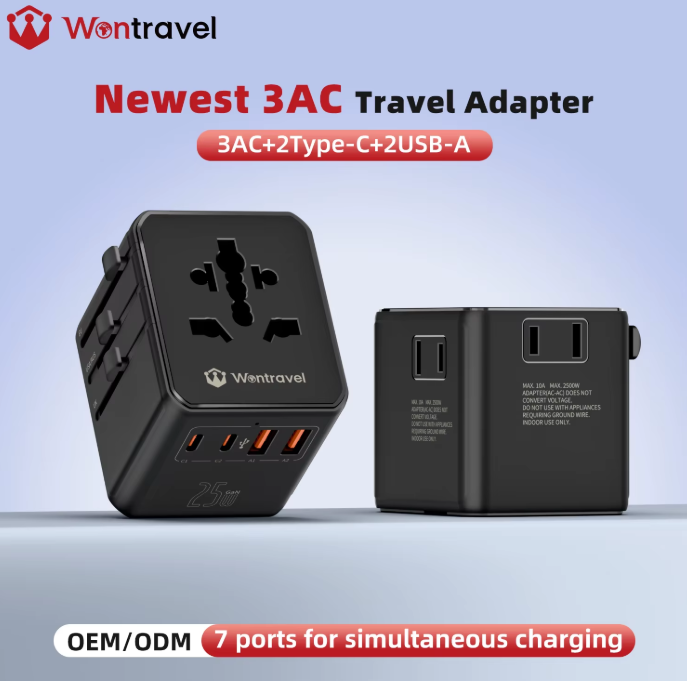
The shift to USB C and fast charging protocols changed the game again. Travelers now carry laptops that charge over USB C, phones that support 45 or 65 watt fast charging, and accessories like earbuds and smartwatches that need their own specific power profiles. A travel adapter that only offers slow USB A ports is no longer enough for many people. The market responded with all in one adapters that include high wattage USB C PD ports alongside legacy USB A ports and the traditional AC socket. This means one compact device can charge a laptop, a phone, and a secondary gadget all at the same time while still letting you plug in something with a standard wall plug. The engineering challenge here is not trivial. Packing a 65 watt or 100 watt power delivery circuit into a device the size of a deck of cards requires careful thermal management and smart circuit design. Badly designed units overheat, throttle their output, or fail after a few months. Good units handle continuous loads without drama. This is where the difference between a cheap import and a properly engineered adapter becomes very obvious.
Safety Standards and the Hidden Cost of Cheap Adapters
One thing many travelers overlook is safety certification. A travel adapter is a device that connects directly to mains voltage in countries with different electrical standards. Some regions run 220 to 240 volts, others 100 to 120 volts. The adapter has to handle that input safely while converting it for USB devices or passing it through to the AC socket. Reputable manufacturers build their products to meet standards like CE, FCC, and RoHS, and they test for overload protection, short circuit protection, and temperature control. Cheap adapters often skip these steps. The result can be melted plastic, fried devices, or even electrical fires in hotel rooms. I remember a traveler who bought a bargain adapter in a street market in Southeast Asia. It worked for two days, then started smoking while charging a phone overnight. The phone survived, but the adapter was a lump of burnt plastic. That kind of experience is why serious travelers now look for safety marks and read reviews before buying. The cost difference between a certified adapter and a dodgy one is small compared to the cost of replacing a damaged laptop or dealing with a hotel fire alarm.
The All in One Adapter as a Travel Essential and Business Opportunity
The modern all in one travel adapter has become one of those products that sits at the intersection of utility and lifestyle. It is not just a tool. It is part of how people organize their travel gear. Many models now include features like swappable plugs for over 150 countries, multiple USB C and USB A ports, surge protection, and compact foldable designs that fit into a carry on pocket. Some even include small night lights or voltage indicators. From a business perspective, this category has grown far beyond the airport souvenir market. Brands, corporate gift programs, and online retailers now source travel adapters in bulk because they make practical and appreciated products. The demand for high quality units that can actually deliver on fast charging promises is strong, especially among business travelers and digital nomads who cannot afford downtime caused by dead batteries.
Why Wanlv is Positioned for the Next Stage of Travel Charging
As travel adapters continue to evolve, the companies that succeed will be the ones that combine engineering capability with a real understanding of how people use these products on the road. Wanlv has focused on travel charging solutions for years, developing adapters that balance size, safety, and charging performance. The company works with retail brands and corporate clients to produce all in one adapters that meet international safety standards and handle the power demands of modern devices. From USB C power delivery to multi region plug mechanisms, Wanlv brings manufacturing experience that helps brands launch products without the usual quality headaches. In a market where one bad charging experience can ruin a trip, that kind of reliability is exactly what customers are looking for. The travel adapter has come a long way from a single piece of plastic at the airport kiosk. The next generation will be smarter, safer, and more powerful, and the brands that deliver that will win loyal customers around the world.
Table of Contents
- The Early Days When One Plug Meant One Country
- The Rise of Multi Region Adapters and Switchable Designs
- The USB Era Changed What an Adapter Had to Be
- Fast Charging and the Arrival of USB C
- Safety Standards and the Hidden Cost of Cheap Adapters
- The All in One Adapter as a Travel Essential and Business Opportunity
- Why Wanlv is Positioned for the Next Stage of Travel Charging