EN
EN



Real travel pain points that drive integrated adapter innovation
Anyone who has taken multi‑stop international trips understands the frustration of managing multiple separate plug adapters. On one recent business journey covering four countries within two weeks, I packed three individual adapters and still faced small troubles. One adapter slipped out of the hotel wall socket, and another got lost deep inside my carry‑on luggage. Many frequent travellers share similar frustrating moments. Before all‑in‑one travel adapters became widely available, people had to purchase separate adapters for European, British, American and Australian wall outlets. Carrying several pieces increases luggage weight and raises the risk of losing small accessories. This real‑life pain pushes hardware engineers to develop one compact unit that can cover most global socket standards.
Precision mechanical design behind multi‑plug integration
Combining four major plug formats into one small plastic shell is far trickier than most consumers imagine. The all‑in‑one travel adapter uses a set of internal sliding retractable pin structures. Each group of metal pins corresponds to one regional plug standard. Users slide or flip physical switches on the outer shell to push the correct set of metal contacts outward for local wall sockets, while keeping other pin groups hidden safely inside the housing. Design teams must fit differently shaped pins for EU, UK, US and AU standards inside limited internal space. Engineers also need to maintain stable metal‑to‑wall‑socket contact pressure. Poor structural design causes loose connections, intermittent power supply or even overheating. Every millimeter of internal layout needs careful calculation to avoid mechanical conflict when different pin sets extend and retract. High‑quality models adopt high‑conductivity copper alloy for pins to guarantee stable electrical performance during long‑hour usage.
Safety compliance sets hard boundaries for multi‑plug hardware
Electrical safety standards around the world set strict rules for travel adapters. Product designers cannot simply stack different pin mechanisms without respecting these rules. Every market has unique testing requirements covering insulation thickness, plug retention force and thermal performance. Independent test laboratories carry out thousands‑cycle plug‑and‑pull durability tests to verify mechanical service life. A well‑designed all‑in‑one adapter must pass CE, FCC, UKCA and RoHS and other global certification requirements. Engineers need to adjust internal mechanical layouts repeatedly during product development so that multi‑plug functions will not break any safety clauses. Many low‑cost uncertified products ignore these constraints. They squeeze too many plug structures into small housings and create hidden fire and electric shock risks for end‑users.
Practical engineering trade‑offs observed in real‑world testing
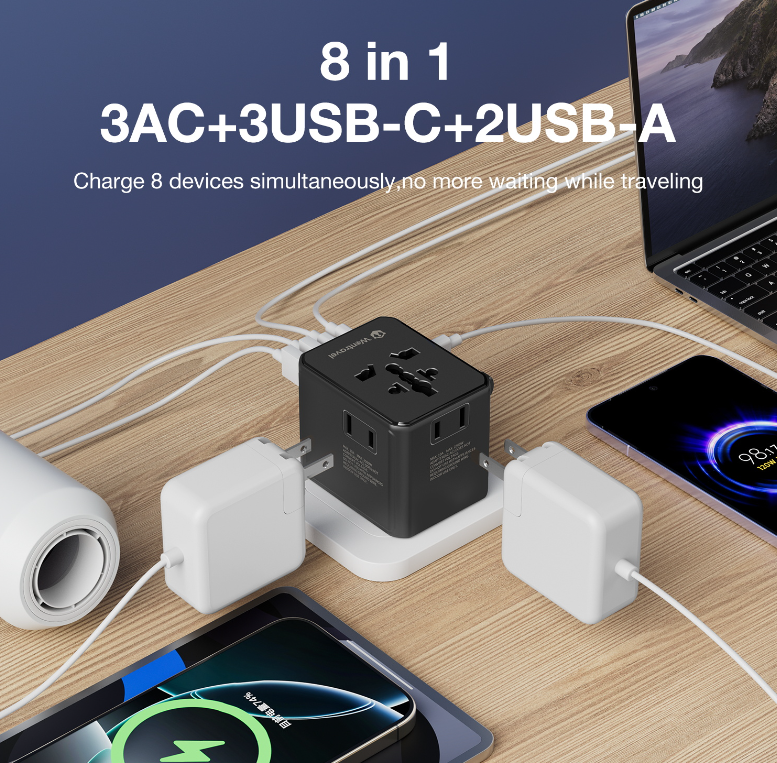
Product teams always face unavoidable trade‑offs during all‑in‑one adapter development. One common conflict lies between compact size and maximum power output. Adding more plug mechanisms occupies internal space, which limits room for built‑in fast‑charging modules. Engineers must balance portability and charging capacity according to target user groups. Field‑test feedback also shapes final product parameters. Early prototype versions sometimes worked perfectly in laboratory environments, yet performed poorly in real hotel wall sockets with aged or slightly deformed socket openings. Developers adjust pin thickness and spring tension repeatedly according to real‑world test data. Transparent product documentation should list clear power limits. Travellers should understand that most universal travel adapters do not convert voltage, so personal electronic devices must support wide‑voltage input to work properly overseas.
Broader commercial value for end‑users and manufacturing partners
For ordinary end‑users, mature all‑in‑one travel adapters cut down luggage clutter and lower the risk of losing small travel accessories. Business travellers, family vacation groups and backpackers all benefit from simplified travel power preparation. Beyond consumer‑facing products, reliable all‑in‑one adapters also represent important custom‑project opportunities for hardware manufacturers. Wontravel holds hundreds of independent patents and maintains complete in‑house production lines. Its ODM and OEM services support custom logo, special‑specification modification and fast sample iteration for global brand clients. The integrated supply chain covers mold development, injection molding, assembly and strict multi‑stage quality inspection, to keep consistent product quality and stable delivery schedules for worldwide partners.
Practical advice for picking reliable all‑in‑one travel adapters
When shoppers compare different all‑in‑one travel adapters, they should not only focus on how many countries a product claims to support. Always check whether target products carry formal safety certifications for your destination markets. Read listed maximum power ratings carefully and avoid overloading adapters with high‑power heating devices. Even well‑built multi‑plug adapters have physical limits. Understanding these basic facts helps global travellers select suitable power accessories and enjoy safer overseas charging experience.
Table of Contents
- Real travel pain points that drive integrated adapter innovation
- Precision mechanical design behind multi‑plug integration
- Safety compliance sets hard boundaries for multi‑plug hardware
- Practical engineering trade‑offs observed in real‑world testing
- Broader commercial value for end‑users and manufacturing partners
- Practical advice for picking reliable all‑in‑one travel adapters