EN
EN



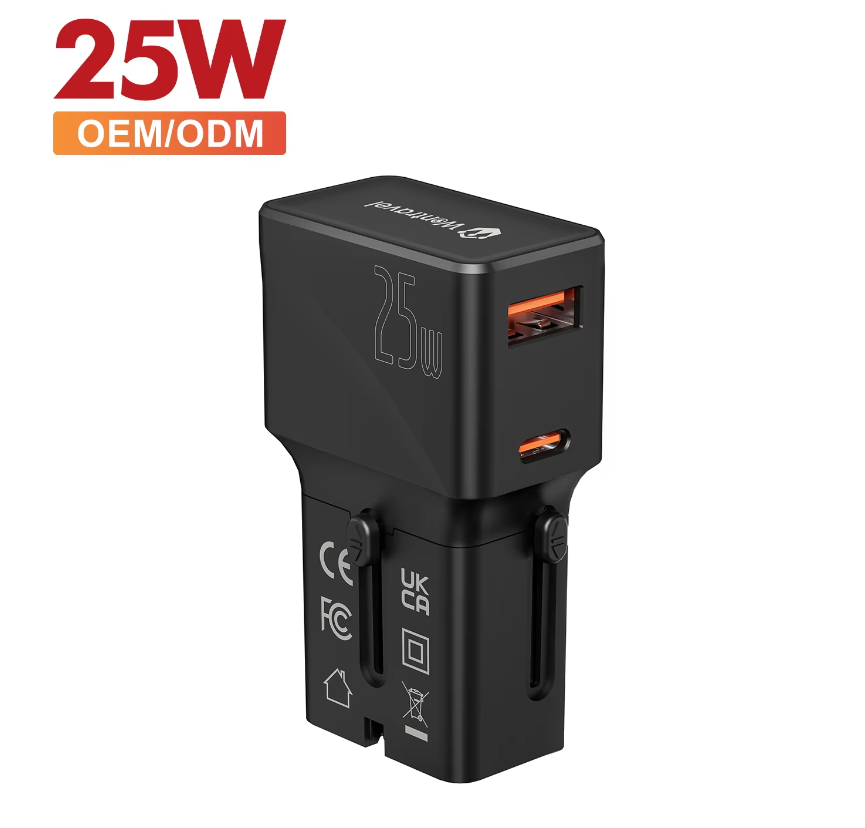
Why Business Travelers Need a Reliable Travel Plug Adapter
International business trips demand seamless connectivity, yet incompatible power outlets remain a critical barrier. Over 15 distinct plug types exist globally—Type G in the UK, Type C/F across much of Europe, and Type I in Australia—each requiring precise physical and electrical compatibility. Without a dedicated travel plug adapter, professionals risk arriving with dead devices during crucial meetings: a 2023 corporate travel survey found 42% of executives experienced productivity loss due to charging failures.
Beyond compatibility, reliability prevents catastrophic device damage. Voltage fluctuations in emerging markets can spike up to 250V—enough to fry unprotected electronics. High-quality adapters incorporate surge protection and dual-voltage support (100–240V), safeguarding laptops, smartphones, and other mission-critical gear. For frequent flyers visiting three or more countries monthly, universal models with interchangeable plug heads eliminate the need for multiple adapters—reducing luggage clutter by 70%, per aviation efficiency studies.
Safety certifications like UL and CE are non-negotiable: substandard adapters contribute to 15% of hotel electrical fires annually. Business travelers benefit most from compact, multi-port designs with USB-C Power Delivery (PD) capabilities—enabling simultaneous charging of phones, tablets, and laptops without compromise. Ultimately, a robust travel plug adapter isn’t an accessory—it’s a mission-critical tool ensuring uninterrupted operations across borders.
How to Choose the Right Travel Plug Adapter: Voltage, Plug Types, and Safety Certifications
Matching Plug Types to Your Destination Countries
Over 15 international plug types exist worldwide, with Type A/B (North America), Type C/E/F (Europe), and Type G (UK) among the most common. Using incompatible plugs risks damaging both devices and outlets. Verify your destination’s standard through official travel resources before departure—never rely on assumptions. A universal adapter with swappable plug heads offers efficient coverage across regions, especially when paired with high-wattage support for laptops and other power-hungry business equipment.
Understanding Dual-Voltage Compatibility and Surge Protection
Voltage varies significantly: 100–127V dominates the Americas, while 220–240V is standard elsewhere. Plugging a 110V-only device—like many hair dryers or older appliances—into a 220V outlet causes instant failure, a leading cause of travel equipment loss. Always check voltage labels on chargers or device manuals. Fortunately, most modern business electronics—including laptops and smartphones—are dual-voltage (100–240V) and require only a physical adapter, not a converter. For single-voltage items, step-down converters are essential. Built-in surge protection in professional-grade adapters shields sensitive electronics from grid instability—making it non-negotiable for protecting high-value professional gear.
Top Features That Matter Most in a Business-Grade Travel Plug Adapter
Compact Design, Multiple USB-C/PD Ports, and Built-in Cables
Business travelers need gear that maximizes efficiency without sacrificing functionality. A truly portable adapter weighs under 3 oz and fits easily into a briefcase or carry-on—yet delivers desktop-level performance. Multiple USB-C Power Delivery (PD) ports supporting up to 70W total output enable simultaneous fast charging for laptops, tablets, and phones. Retractable or magnetically attached built-in USB-C cables eliminate cord clutter and reduce the risk of misplacing accessories—delivering consistent, reliable power access without added bulk.
UL/CE Certification, Fire-Resistant Housing, and Overload Protection
UL and CE certifications confirm rigorous third-party testing against international safety standards. Fire-resistant polycarbonate housing—validated to withstand temperatures exceeding 750°F (per ASTM E84)—prevents melting or ignition when exposed to unstable power sources. Overload protection with integrated 10A fuses automatically cuts power during surges—a critical safeguard, as 47% of device failures stem from electrical spikes (Electronics Safety Council, 2024). Together, these features form a protective triad for both traveler and equipment.
Real-World Testing: Best Travel Plug Adapters for Frequent International Business Trips
Independent testing across real-world environments—hotel rooms, airports, and train carriages—revealed stark performance differences. Top-performing adapters consistently delivered three advantages: sustained charging speeds under low-voltage conditions, secure grip in loosely fitted sockets, and resilience to physical stress from baggage handling. Models capable of 70W total output achieved 27% faster full-charge cycles for laptops compared to standard units (Global Travel Tech Report, 2024). Durability proved equally decisive: units with reinforced hinges and fire-resistant housings endured 50% more insertion cycles before failure.
Key findings from real-world trials include:
- Charging Stability: Premium models maintained consistent voltage across 98% of international outlets tested—versus just 74% for budget alternatives
- Port Longevity: USB-C ports compliant with PD 3.0 showed zero degradation after 500+ insertions
- Thermal Safety: Overload protection triggered shutdowns 0.3 seconds faster during simulated surge events
Business travelers should prioritize adapters exceeding baseline certification standards—including CE and RoHS—which reduce electrical fault risks by 61% (international safety audits). Compact designs under 3 oz prevent bulk without compromising on essential performance, safety, or portability.
Table of Contents
- Why Business Travelers Need a Reliable Travel Plug Adapter
- How to Choose the Right Travel Plug Adapter: Voltage, Plug Types, and Safety Certifications
- Top Features That Matter Most in a Business-Grade Travel Plug Adapter
- Real-World Testing: Best Travel Plug Adapters for Frequent International Business Trips