EN
EN



The pile of chargers that never gets used on trips
Travelers often pack more charging gear than they actually need. A universal plug adapter for the destination country, a separate USB wall charger for a phone, maybe a second charger for a tablet or e-reader, and then a handful of cables. All of these items add weight and take up space in a carry-on bag that already has strict limits. According to the International Air Transport Association, most economy class passengers are allowed only one carry-on bag plus a small personal item, and the bag typically must weigh under 7 kilograms. Every gram counts when a laptop, documents, and a change of clothes are competing for space.
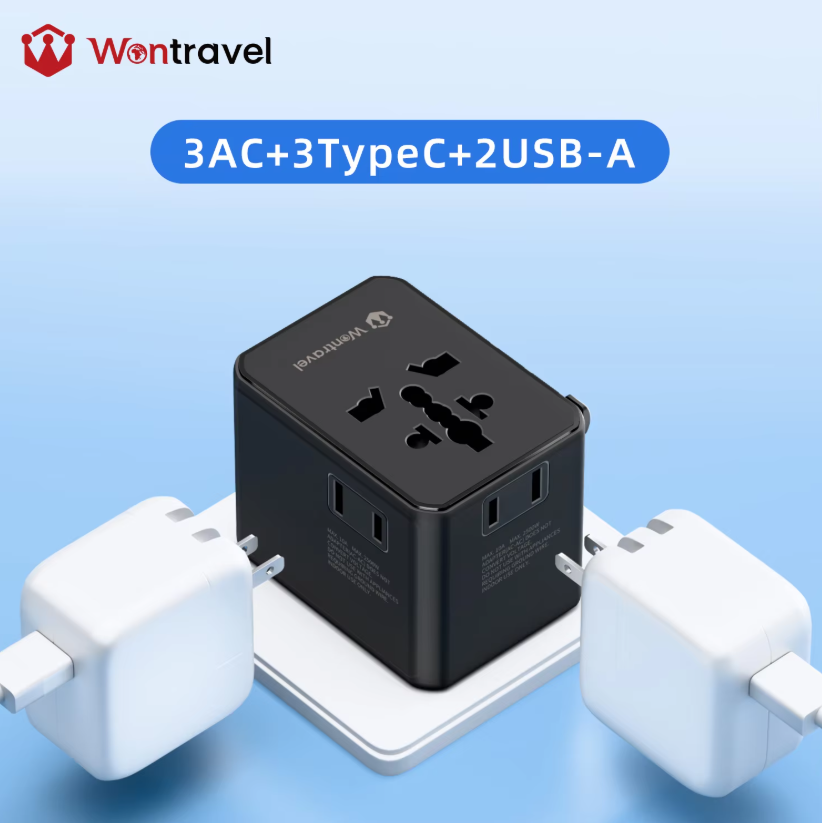
An all in one travel adapter attacks this problem directly by combining the functions of several devices into a single housing. Instead of carrying a country-specific plug adapter and a separate USB charger, a traveler can carry one device that handles both jobs. The packing space saved might seem small on paper, but over multiple trips and across multiple users, the reduction in clutter is significant.
Why separate adapters and chargers create hidden friction
The problem with carrying separate devices is not just the weight. It is the mental load of keeping track of multiple small objects in a hotel room, an airport lounge, or a cramped train seat. Each item has a specific purpose, and if one gets left behind, the whole charging setup becomes less useful. A plug adapter without a USB charger cannot fast-charge a phone. A USB charger without a plug adapter is useless in a country with different sockets.
Moreover, separate devices often have different voltage ratings and plug types. A traveler moving between the United Kingdom, continental Europe, and North America may need three different plug adapters just to connect a standard USB charger. That means three more small objects to lose. A well-designed all in one travel adapter removes this friction by integrating the plug selection mechanism and the USB power supply into one unit.
The functional overlap that makes consolidation possible
Modern USB charging standards have made consolidation much easier. USB Power Delivery and Qualcomm Quick Charge allow a single USB-C port to negotiate different voltage and current levels with different devices. A laptop that needs 20 volts and a phone that needs 5 volts can both be served by the same port, provided the adapter can deliver enough wattage. This was not always the case. Older USB chargers were limited to 5 volts and low currents, so separate chargers for different devices made more sense.
The shift to gallium nitride power components has also reduced the physical size of high-wattage power supplies. A 65-watt GaN charger is roughly half the size of an equivalent silicon-based charger from a decade ago. That size reduction allows manufacturers to fit a capable USB-C power supply inside a travel adapter without making the whole package bulky.
|
Packing Item |
Traditional Setup |
All-in-One Adapter |
|
Plug adapters |
2–3 country-specific pieces |
1 integrated sliding mechanism |
|
USB wall chargers |
1–2 separate bricks |
Built into adapter |
|
Total items to track |
4–6 |
1 |
|
Estimated weight |
250–400 g |
150–250 g |
|
Carry-on volume |
Scattered, hard to pack |
Single compact block |
|
Fast charging support |
Varies by device |
One USB-C PD port |
A real-world packing audit from a frequent flyer
A sales director who flies between Singapore, Germany, and Canada at least twice a month decided to audit what charging gear actually got used during a three-week trip. The audit found that out of six items packed, only two were used every day: a phone charger and a laptop charger. The three plug adapters were used only when moving between hotel rooms, and one spare cable never left the bag.
After switching to a single all in one travel adapter with a 65-watt USB-C port and an additional USB-A port, the packing list dropped from six items to two: the adapter and one cable. The total weight saved was about 180 grams. That might not sound like much, but it was enough to bring an extra battery pack or a small camera without exceeding the airline hand luggage limit. The adapter also eliminated the risk of arriving in a new country and realizing the wrong plug adapter had been packed.
Honest limits of the all-in-one approach
A consolidated adapter is not perfect for every traveler. Someone carrying multiple high-wattage devices, like a gaming laptop and a drone charger, may still need a dedicated charger because the built-in USB port might not provide enough power for simultaneous fast charging. Some countries have recessed sockets or unusual grounding arrangements that can make an integrated plug mechanism feel less stable than a dedicated plug adapter. And if the adapter fails, the traveler loses both plug conversion and USB charging at once, which is a risk worth considering for long trips to remote areas.
These limitations do not undermine the core benefit, which is simplicity. For the majority of business travelers and vacationers who need to charge a phone, a tablet, and maybe a lightweight laptop, an all in one travel adapter removes a surprising amount of packing friction.
Compact design depends on manufacturing discipline
Making a reliable all-in-one adapter is not just a matter of shrinking components. The mechanical plug system must survive thousands of insertions without loosening. The USB power supply must stay cool enough inside a closed plastic shell to avoid degrading the internal components. The circuit board must be laid out so that high-voltage AC paths stay safely separated from low-voltage USB outputs. These are not trivial requirements, and they show up in the difference between a product that lasts years and one that fails after a few trips.
Wontravel has been building this type of product since 2008, with in-house capabilities in mold design, injection molding, electronic circuit development, and final assembly. That vertical integration makes it easier to control the tolerances and material choices that determine whether a travel adapter earns a permanent spot in a carry-on bag or gets replaced after the first long-haul flight.
Table of Contents
- The pile of chargers that never gets used on trips
- Why separate adapters and chargers create hidden friction
- The functional overlap that makes consolidation possible
- A real-world packing audit from a frequent flyer
- Honest limits of the all-in-one approach
- Compact design depends on manufacturing discipline