EN
EN



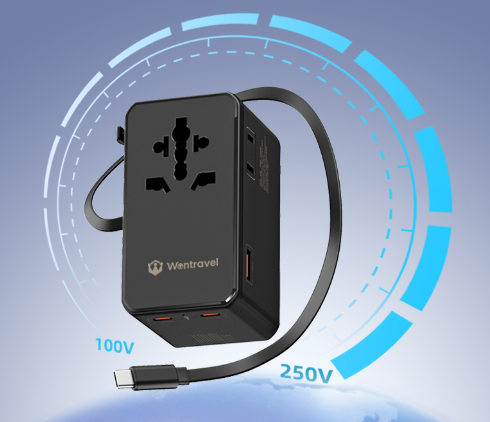
The quiet engineering challenge hiding in a pocket-sized device
Most travelers never think about what goes into an all in one travel adapter until one fails in a hotel room at midnight. That moment of frustration is actually the result of dozens of design tradeoffs made months or years earlier. Packing multiple plug standards, voltage compatibility, USB power delivery, and mechanical locking systems into a device smaller than a deck of cards is not a trivial task. It is a continuous negotiation between electrical safety, mechanical durability, thermal management, and cost.
The real difficulty comes from the fact that different countries use radically different socket geometries. A plug that works in Germany will not fit a wall outlet in Japan or the United Kingdom. An adapter that claims to handle all of them must include moving parts, sliding rails, retractable pins, and spring-loaded contacts. Every one of those moving parts adds complexity, and complexity always brings failure points. Good industrial design is about managing that complexity without making the product feel fragile or confusing.
Why socket geometry forces designers into uncomfortable corners
Socket standards are not just different shapes. They are different philosophies about electrical safety. The British BS 1363 plug is large, fused, and heavily shrouded. The European Schuko system relies on deep recessed sockets and side grounding clips. The North American NEMA system uses thin flat blades with a simple grounding pin. The Australian and Chinese systems use angled flat blades with different spacing rules.
A designer working on a universal adapter has to accommodate all these forms in one chassis. That means creating sliding mechanisms that expose the right pins while locking others away. The mechanical tolerances involved are surprisingly tight. If a pin moves even half a millimeter too far, it can jam. If a locking tab wears down after a few hundred insertions, the whole mechanism becomes unreliable. Travelers may only use the adapter a few dozen times per year, but each insertion must feel solid and secure because a loose connection generates heat.
Thermal behavior is the invisible design constraint nobody talks about
Heat is the enemy of any compact electrical device. When a travel adapter converts AC power and also steps down voltage for USB ports, the internal components generate waste heat. In a device this small, there is almost no room for heat sinks or airflow. The plastic housing itself must act as a thermal barrier while also dissipating enough energy to keep internal temperatures within safe limits.
Modern gallium nitride components have changed this equation somewhat. GaN semiconductors switch more efficiently than older silicon parts, producing less heat for the same power output. That allows smaller adapters to handle higher wattages without melting or deforming. But the mechanical parts still matter. A sliding pin mechanism with poor contact pressure can create resistance heating at the interface, and that heat can soften surrounding plastic over time. Good designs use high-temperature engineering plastics like polycarbonate blends or glass-filled nylon for the moving parts, not the standard ABS found in cheaper products.
A real-world case from a humid coastal manufacturing town
A few years back, an engineering team at a factory near the South China coast was troubleshooting a batch of universal adapters that failed accelerated life testing. The failure mode was not electrical. The sliding pin mechanism would become sticky and inconsistent after roughly 3,000 cycles. Disassembly showed a fine layer of oxidized copper dust accumulating inside the guide channels. The combination of high humidity, salt air from the nearby coast, and repeated friction was wearing down the brass contacts faster than expected.
The fix involved two changes. First, the contact material was switched from standard brass to a phosphor bronze alloy with better wear resistance and lower oxidation rates. Second, the guide channels were redesigned with small debris traps, shallow pockets that collected dust away from the sliding surfaces. Neither change was visible from the outside, but both extended the cycle life well beyond the required 6,000 insertions. This kind of iterative refinement is what separates a reliable travel accessory from a disposable one.
How material selection defines the user experience
The tactile feel of an adapter matters more than most people realize. When a traveler plugs in a device, the resistance should feel firm but not stiff. The sliding mechanism should snap into place with a confident click. The housing should feel dense and cool to the touch, not hollow or creaky.
These qualities come from material choices. A well-designed adapter uses a combination of materials: flame-retardant polycarbonate for the outer shell, glass-fiber-reinforced nylon for internal structural parts, phosphor bronze or beryllium copper for electrical contacts, and sometimes a soft-touch coating on the grip areas. The wall thickness of the housing is not uniform. Load-bearing sections around the plug mechanism are thicker, while non-structural areas are thinner to save weight and material cost. The difference between a premium adapter and a budget one is often visible only in these internal details.
|
Design Factor |
Budget Adapter |
Premium Adapter |
|
Housing material |
Standard ABS |
Flame-retardant polycarbonate blend |
|
Contact material |
Plain brass |
Phosphor bronze or beryllium copper |
|
Moving part tolerance |
±0.5 mm |
±0.1 mm or tighter |
|
Cycle life before wear |
1,000–2,000 insertions |
6,000+ insertions |
|
Thermal protection |
Basic fuse |
Fuse plus thermal cutoff |
|
USB output regulation |
Loose voltage swing |
Tight regulation within ±3% |
The manufacturing side is where most designs quietly fail
A brilliant CAD model does not automatically become a reliable product. The injection molding process, assembly line layout, and quality control checkpoints determine whether the final adapter matches the design intent. Multi-shot molding is often used to combine hard and soft plastics in one piece, reducing assembly steps and improving durability. Automated optical inspection catches misaligned pins before products are packed. Torque testers verify that sliding mechanisms require consistent force across the entire production batch.
These processes are expensive. A factory that invests in automated inspection and tight process controls will produce fewer defects but at a higher unit cost. That is why the gap between a $15 adapter and a $40 adapter is not just brand markup. The cost goes into tooling precision, material purity, and the statistical confidence that every unit leaving the line will behave like the sample that passed certification.
Certification matters here. Reputable adapters are tested against standards like IEC 60884 for plugs and sockets, UL 1310 for power supplies, and various regional safety requirements. These tests are not pass or fail once. They involve repeated temperature cycling, drop tests, and overload conditions that simulate years of abuse in a few weeks.
Why all-in-one designs continue to get better
The travel adapter category has advanced significantly over the past decade. Early universal adapters were bulky, mechanically clunky, and limited to low wattages. Today, compact models handle fast charging protocols, work in over 150 countries, and include features like auto-resetting fuses and child-safe shutters. The progress comes from better semiconductor technology, improved mold-making precision, and a deeper understanding of how travelers actually use these products in the field.
Wontravel has been part of that evolution since 2008, with in-house capabilities spanning mold design, injection molding, electronic circuit development, and final assembly. That vertical integration allows tighter control over the small details that determine whether an adapter feels solid after two years of travel or becomes another piece of airport garbage.
Table of Contents
- The quiet engineering challenge hiding in a pocket-sized device
- Why socket geometry forces designers into uncomfortable corners
- Thermal behavior is the invisible design constraint nobody talks about
- A real-world case from a humid coastal manufacturing town
- How material selection defines the user experience
- The manufacturing side is where most designs quietly fail
- Why all-in-one designs continue to get better