
 EN
EN



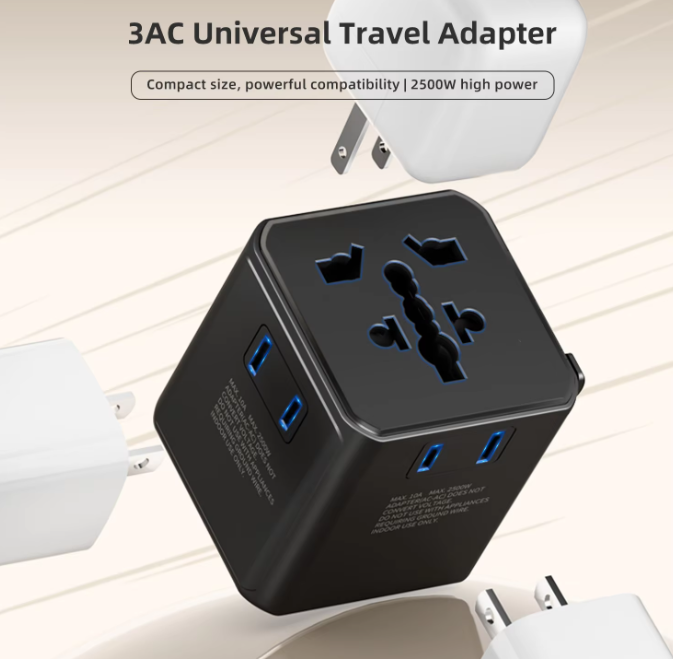
If you have shopped for a travel adapter recently, you have probably seen the phrase "works in over 200 countries" printed on the box. It sounds impressive. And honestly, it is. But what does that number actually mean when you are standing in a hotel room in a country you have never visited before, staring at an outlet that looks unfamiliar? Does it guarantee that you will be able to charge your phone anywhere? Or is it just marketing language?
Let us break down what "200+ countries" really means for someone who actually travels.
The Four Main Plug Types Cover Most of the World
When you look at the variety of plugs around the world, it can seem overwhelming. But the reality is simpler. Almost every country in the world uses one of four main plug types. There is the Type A and Type B with two flat pins, which you see in North America and parts of Central and South America. There is the Type C with two round pins, common across most of Europe and many other regions. There is the Type G with three rectangular pins, which is the standard in the United Kingdom, Ireland, and former British colonies. And there is the Type I with two or three flat pins angled in a V shape, used in Australia, New Zealand, China, and Argentina.
A quality worldwide travel adapter includes all four of these configurations in one device. When a product claims compatibility with over 200 countries, it is essentially saying that by covering these four plug types, it works in almost every country that has an established electrical grid. So, when you land in Paris, you slide out the two round pins. When you get to London, you push out the three rectangular pins. The adapter covers the bases without you having to carry a separate piece for each region.
Not Every Country Has a Unique Plug
One thing that surprises many travelers is that many countries share the same plug type. For example, the two round pin Type C plug is used in France, Germany, Italy, Spain, Greece, and dozens of other European and non European countries. The Type G plug used in the UK is also the standard in Singapore, Hong Kong, Malaysia, and several Middle Eastern countries. So, when an adapter says it works in over 200 countries, it is not claiming to have 200 different settings. It is providing the four or five standard configurations that collectively cover all those places.
This matters because it simplifies what you need to carry. You do not need to research the plug type of every single country on your itinerary. You just need one adapter that has the major types built in. When you are traveling across multiple continents, that simplicity is a huge relief. You are not packing a bag full of different adapters or worrying about losing the one you need for the next leg of your trip.
What the Number Does Not Tell You
While "200+ countries" is a useful claim, it does not tell the whole story. There are a few things it leaves out. First, it does not tell you about voltage. Some adapters are purely mechanical. They change the shape of your plug but do nothing to convert voltage. If your device is not dual voltage, you still need to be careful. A worldwide travel adapter that includes voltage conversion adds an extra layer of usefulness, especially if you travel with devices like hair dryers or electric shavers that may not handle 220 volts well.
Second, the number does not tell you about safety certifications. A product that claims to work in many countries should ideally have safety marks like CE, FCC, RoHS, or others that demonstrate it has been tested to international standards. Without those, you are taking a gamble with your expensive electronics.
Third, it does not tell you about physical fit in every situation. Some outlets in older buildings or certain regions can be recessed or have unusual shapes. A well designed adapter accounts for this with longer pins or a slimmer body that can fit into recessed sockets. The claim of working in 200 countries is based on the standard outlet types, but real world conditions can vary.
The Real World Benefit: One Less Thing to Worry About
For the traveler, the practical benefit of a worldwide travel adapter is not just about the number of countries. It is about mental bandwidth. When you are navigating unfamiliar airports, managing jet lag, and keeping track of your itinerary, the last thing you want to think about is whether your charger will fit in the wall. Having an adapter that you know will work anywhere means one less variable to manage.
You can pack it once and forget about it until you need it. Whether your trip takes you through a single continent or across three, the same adapter covers you. This is especially valuable for business travelers who move quickly between countries and cannot afford to waste time hunting for a compatible adapter at a local electronics shop. It is also a huge help for families traveling with multiple devices who just want everything to work without fuss.
When "200+ Countries" Might Still Leave You Stuck
There are a few scenarios where even a good worldwide travel adapter might not be enough. Some countries use older outlet styles that are less common. Parts of South Africa, for instance, use a three round pin plug that is not covered by the standard four types. Certain outlets in India combine features from different standards. And in very remote or rural areas, you might encounter outlets that do not match any modern standard.
That said, these situations are the exception, not the rule. For the vast majority of travel to major cities, airports, hotels, and tourist destinations, the standard four plug types will cover you. If you are planning to spend extended time in a country with a less common outlet type, it is worth checking ahead. But for most travelers, a quality worldwide travel adapter that includes the major configurations will handle nearly everything they encounter.
What to Look for Beyond the Number
When choosing an adapter, do not just look at the country count. Look at the features that make it practical in real travel. Check whether it includes USB ports. In a hotel room with limited outlets, having built in USB ports means you can charge your phone and your laptop from the same adapter without needing separate chargers. Look at the power rating. If you travel with a laptop, make sure the adapter can handle the wattage. Some adapters are designed only for lower power devices like phones and cameras.
Look at the build quality. Pins should feel sturdy, and any sliding or folding mechanisms should operate smoothly without feeling flimsy. Safety features like a fuse and thermal protection add peace of mind. Finally, consider the size. A compact adapter is easier to pack and less likely to get left behind.
At the end of the day, "200+ countries" compatibility is a meaningful promise. It means the adapter has been designed to handle the four major plug types that cover most of the world. It means you can travel across continents with one small device and stay powered up without constantly worrying about whether your charger will fit. For the traveler, that is not just a number. It is the freedom to focus on the journey instead of the logistics. And in a world where travel can already feel complicated, that kind of simplicity is worth a lot.